Neighbourhood grocery store: how do you keep shelves in order with a small team?
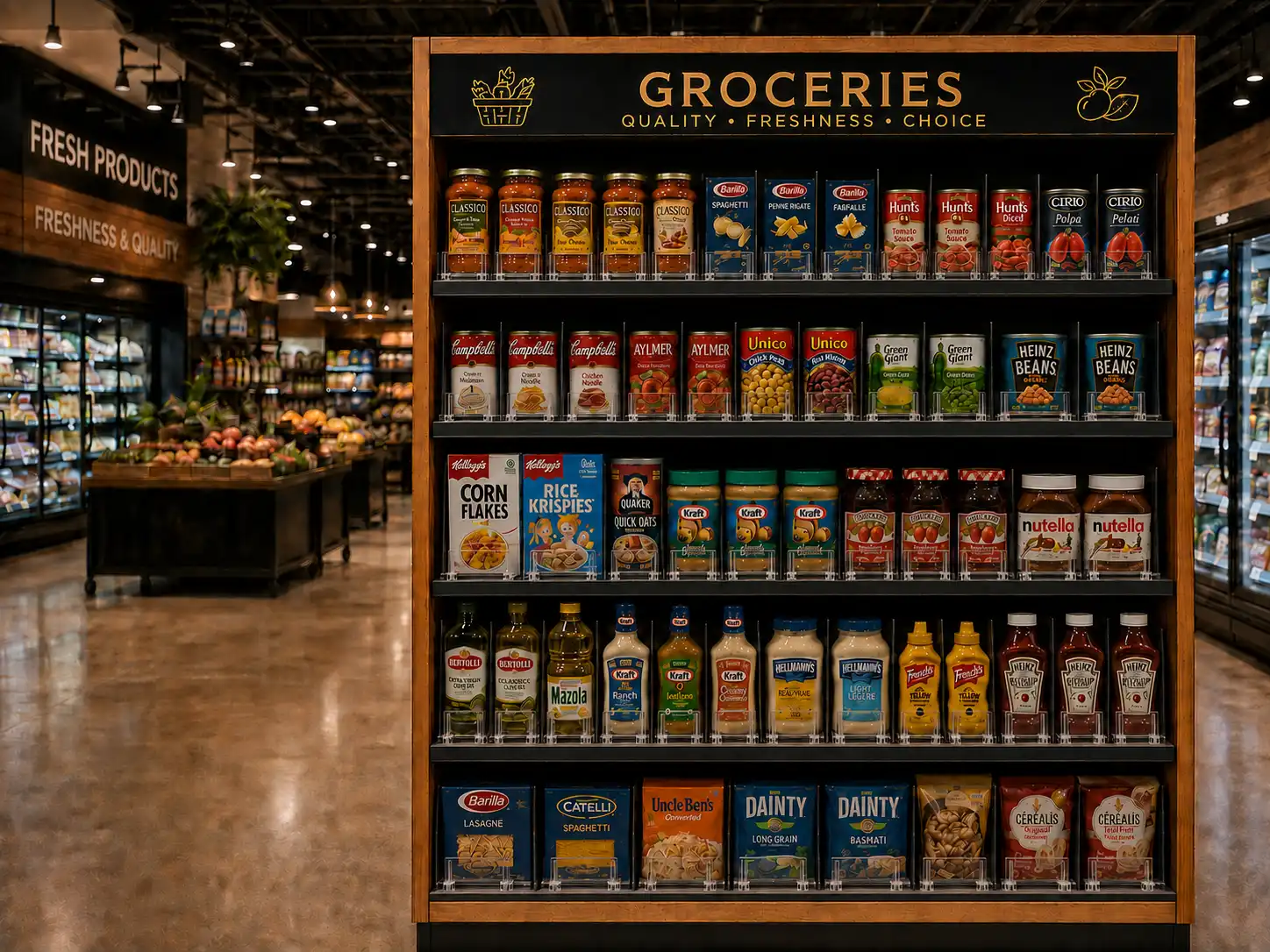
A neighbourhood grocery store fits a wide assortment onto a few shelves, and there is rarely anyone free to face the products. The method comes down to four habits: group each family, keep the front row full, put weight on the bottom shelves and give every item a label that stays in place.
Every shelf counts
An aisle that reads at a glance
Configured to your shelves
Neighbourhood grocery store: what keeps an aisle in shape
In a small grocery store, order cannot rely on repeated refacing: nobody can do it several times a day. It has to be built into the shelf itself. Each family holds a fixed zone, every product gets its own lane, and a pusher brings the next unit to the edge as soon as a shopper takes one.
This page walks through one way to get there, from the aisle plan to the measurements to send us. The full range of components and departments is covered on our page about grocery shelf management systems.
| At a glance | What you see | What helps |
|---|---|---|
| Floor space | Many SKUs on few shelves | Narrow lanes, sized to each item's format |
| Staff | Little free time between the till and receiving | Pushers that bring the next unit to the edge |
| Assortment | Very different formats on the same shelf | Shelf dividers between families and varieties |
| Shoppers | They come for one specific item, and fast | A label holder lined up with every lane |
| Heavy formats | Awkward to handle up high | Bottom shelves, with components built for the weight |
| Where to start | The urge to redo everything at once | The busiest section first, then the rest |
Group by family before thinking about components
Shoppers at a local store often come in for something specific: whatever is missing for dinner, or an item forgotten elsewhere. The aisle should follow that logic. What gets used for the same meal sits side by side, and each family keeps its address from one week to the next, so regulars head straight to it.
Within a family, sort by format, then by variety. That double sort gives the aisle a steady rhythm: large formats on one side, small ones on the other, and related flavours grouped instead of scattered.
The plan comes before the hardware. Shelf dividers only make visible the boundaries that have already been decided: placed on a poorly sorted aisle, they lock the mess in. Once families are in place, they stop an item put back in the wrong spot from spilling into the next lane, and the shelf keeps its shape between staff rounds.
A full front row, even between rounds

Shoppers often take the unit at the front. On a deep shelf, the row therefore empties at the front, and whatever is left at the back vanishes from view. The shelf looks bare while the stock is still there, and the product is assumed to be sold out.
A pusher fixes this at the source. The mobile pusher drives the row toward the edge, and every pick frees space for the next unit. Two mechanisms are available, spring or pull-tab. The calibrated spring applies continuous forward pressure, useful in lanes that turn over quickly; the pull-tab brings the whole row forward in a single motion at restocking time, which suits a team that works in rounds.
The model depends on the merchandise. ROBUSTA handles packaged goods, including heavy and bulky formats, on bases up to 24 in deep. PRESTIGE is built for small items: boxes up to 5 in wide by 4 in high, weighing no more than 50 g. COMPACT, fully translucent and offered with a spring only, keeps light formats at the shelf edge, and each of its lanes reloads from the front. To see them together, visit our page to compare our 4 models.
Weight on the bottom, one label per lane
Shelf height is a decision too. Heavy formats belong on the bottom: they are easy to grab and they do not load the upper shelves. At those levels, ROBUSTA offers 4 in dividers that hold dense rows, along with an XXL support plate of 4 in by 6 in for tall packages that might tip over.
One limit is worth stating: large containers of liquid are not pushed. They are organized with dividers and label holders, without a pusher.
Then comes the label. In a small store, shoppers read the price before reaching for the product, and a label that no longer matches the item in front of it slows everyone down, at the till and in the aisle. The divider sets the lane; the label holder or price moulding, placed in line with it, stays in front of the right item. Our online shop also carries price mouldings and label holders in several models.

Tell us about your store and its shelves
Ready to improve product visibility and shelf organization across your grocery departments? Tell us about your store layout, product categories and merchandising goals. Our team can help you design a custom shelf management system using shelf pushers, dividers and label holders adapted to your retail environment.
Request a Quote
Start with the busiest section
Equipping the whole store at once is neither necessary nor wise. Choose the section that empties fastest, or the one where shoppers keep asking for help, and handle it first. It becomes the test bed where the family plan, the lane widths and the mechanism are confirmed.
With some hindsight, the team sees what has changed in its routine: less refacing, and a row that can be checked at a glance from the aisle. Because every system is designed and manufactured to measure, nothing forces you to standardize: each aisle gets the components that suit it.
What we prepare from your measurements
We do not propose a configuration from a general description. For a neighbourhood grocery store, the request starts with a few concrete details:
- The interior dimensions of your shelves: width, depth and available height.
- The measurements and weight of one unit of each product to equip.
- The number of facings you want, and how many shelves or sections are involved.
- Your preferred mechanism, spring or pull-tab, if you have one.
- Photos of the shelf and the products, taken from the front and the side.
With those details, our team sets the lane width, the model, the mobile pusher height and the type of retaining strip. When an item goes beyond what one model can carry, we suggest another instead of forcing the assembly. If your business works more like a counter-service corner shop, our page on convenience store shelf management systems covers those specific needs.
Neighbourhood grocery store: your questions
Which section should a small grocery store start with?
The one that empties fastest, or the one staff keep straightening. It serves as a test bed: the sort, the lane widths and the mechanism are confirmed there, then the method extends to the neighbouring aisles.
Does every lane need a pusher?
No. A pusher earns its place where the front unit leaves often and lets the rest slide out of sight. Items that stand on their own, as well as large containers of liquid, which should not be pushed, sit neatly between shelf dividers with a label holder.
Can our existing shelves take pushers?
That is where every configuration starts: the bases sit on the shelf, and we build the setup from its interior dimensions. Width, depth and available height decide the model and the number of lanes, and we confirm the fit from your measurements.
How do you keep each price in front of the right product?
Set the lane before placing the label. The divider keeps the item from drifting into the next lane, and the label holder or price moulding, placed in the same line, stays in front of it. Shoppers then read the right price without hesitating.
Do supermarket components work in a small store?
They are the same families of parts: pushers, shelf dividers and label holders. What changes is the configuration, based on your own shelves and formats. A small store often calls for narrow lanes, adjusted to each shelf.
Which section should a small grocery store start with?
The one that empties fastest, or the one staff keep straightening. It serves as a test bed: the sort, the lane widths and the mechanism are confirmed there, then the method extends to the neighbouring aisles.