Spring or pull-tab shelf pushers: which one should you choose?
By Mathieu St-Germain
On a well-stocked shelf, the mess always starts the same way: a shopper takes the front item, and the front of the row starts to empty. Spring or pull-tab shelf pushers both bring merchandise back to the edge, but each follows its own logic and timing. One works nonstop; the other waits for your move.
This guide will help you decide: four simple questions, the mechanism each Concept P.O.S. model offers, a concrete example and the limits worth knowing before you order.
Spring or pull-tab: what each mechanism does
With the calibrated spring, merchandise is pushed toward the front at all times. As soon as the lead unit leaves the shelf, the next one slides into its place, with no action needed from shopper or staff. The row resets itself all day long, which suits lanes with sustained turnover.
The pull-tab works differently. Between rounds, merchandise sits wherever it was left; then one pull, whenever you decide, returns the whole row to the edge. This mechanism therefore fits aisles restocked in rounds, where staff reface each lane as they go by.
Put simply, the spring bets on continuity, the pull-tab on routine. To see why a full front row matters, read our article on front-facing shelves and product visibility.
Four questions to ask before you choose
Before talking models, look at your aisle as it really runs.
- How fast does the row empty? A lane that shoppers draw from nonstop benefits from continuous pressure: the following item is already waiting at the edge. A lane that moves in waves copes better with refacing at set moments.
- How does your team restock? If staff walk the aisles at fixed times, the pull-tab slips into that round: one motion per lane, and everything is back up front. If nobody has time to come back, the spring works alone.
- What does a unit weigh, and what is its format? On the lightest items, such as those the Compact handles, a pull-tab would add little. With heavy formats, on the other hand, bringing several units forward at once becomes a useful move.
- How deep is your shelf? On a deep shelf, the last units hide at the back, and the row looks empty before it actually is. Each model has its documented range, and some versions set a minimum: the narrow pull-tab Prestige, for instance, starts at 12 in.
Picture a convenience store whose team walks the floor every morning and evening: the pull-tab fits easily into that routine. By contrast, a busy deodorant wall in a pharmacy would benefit from a spring that never takes a break.
Write your answers down: our team will ask you these same questions. To follow the whole path, from the first measurements to installation, see how a shelf upgrade project unfolds.
Spring or pull-tab shelf pushers: which model offers which mechanism?
Concept P.O.S. designs and manufactures four automatic-facing pusher models. Not all of them offer a choice of mechanism, and that point often steers the decision.
Robusta. Built for packaged products in busy aisles, right up to heavy and bulky formats: jars, canned goods, prepared meals, beverages. Its bases, 2 in or 2.5 in wide, cover depths of up to 24 in, and it works with a spring as readily as with a pull-tab.
Prestige. It targets small items sold in pharmacies and supermarkets: hair colouring, deodorants, tablets, nail polish. It takes boxes no larger than 5 in wide and 4 in high, weighing up to 50 g, on a 2 in track or a narrower 1.5 in one. Both mechanisms are offered.
Compact. Fully translucent, it serves light, small-format products (cigarettes, medicine cartons, cosmetics) as well as cash and pharmacy laboratory drawers. Its tracks reach 22 in deep, with a custom width of up to 48 in. No pull-tab here: it runs on a spring only, because on packaging this light, a second mechanism would complicate the assembly without fixing anything.
Blizzard. It targets cold settings first, refrigerated or frozen, and its components are validated for the conditions where they will be installed. Its mechanism is not fixed in advance: our team works it out with you during configuration, based on the merchandise, its packaging and the installation temperature.
The pull-tab in practice, and the limits to know
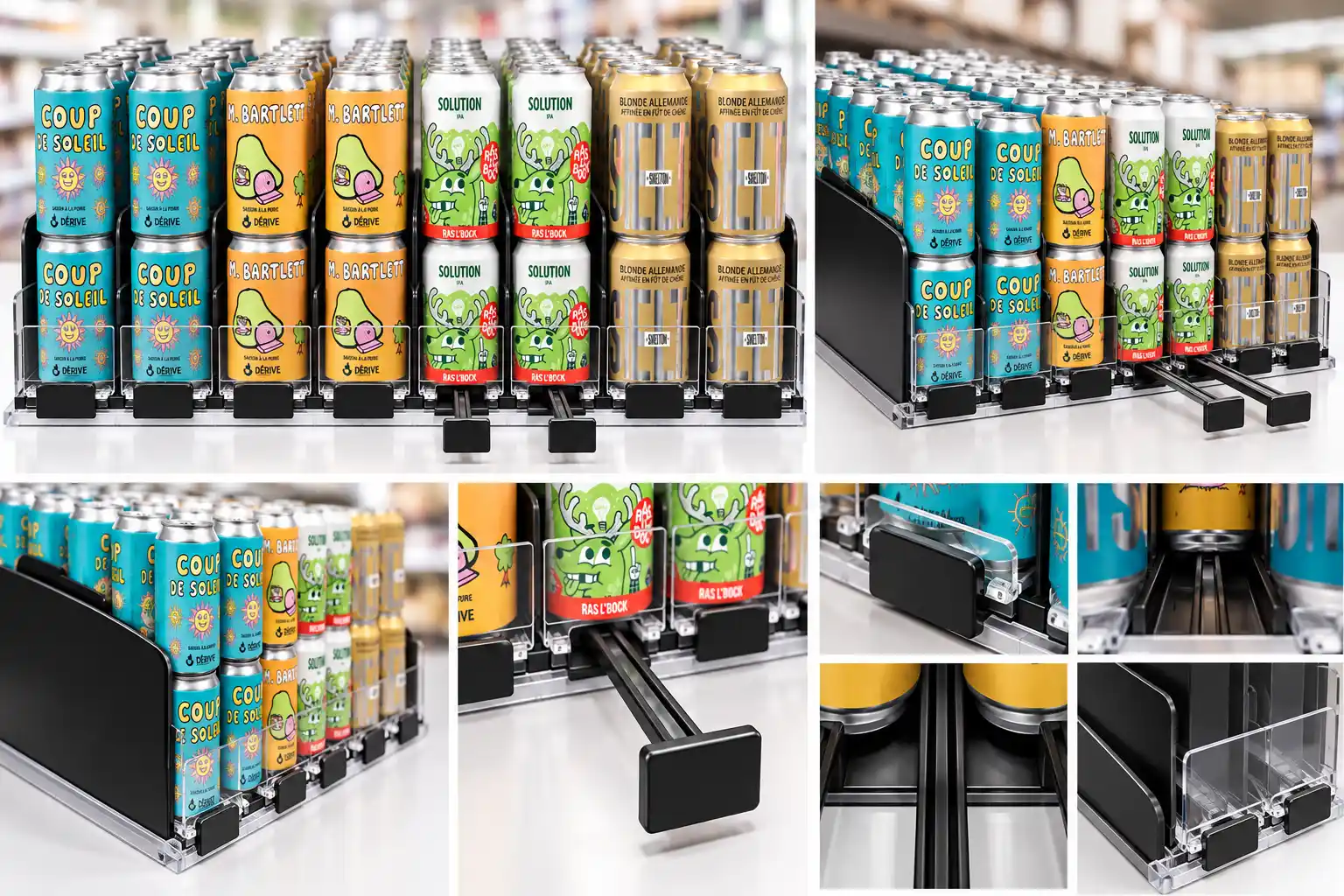
Take cans stacked two levels high, a setup Concept P.O.S. presents on the Robusta pull-tab with 473 ml cans. By hand, staff have to lift off the upper row, push the units underneath forward, then set everything back in place. With the pull-tab, a single motion brings the entire column back to the edge, upper level included. Our article on double-stacked cans and the Robusta pull-tab covers it in detail; if those drinks are sold chilled, though, the project is reviewed with our team, since cold aisles belong to Blizzard.
Even a well-chosen pusher has its limits. Vehicle batteries and heavy jugs of liquid are good examples: no model or mechanism should push them. For those, dividers and label holders do the organizing and keep each lane readable.
Another limit is the documented range. Beyond the depth listed for a model, nothing is extrapolated; the configuration is checked with our team. No load capacity is published either: compatibility with a product is confirmed from measurements, never from a description alone. The final choice of mechanism, too, is based on your actual products.
Frequently asked questions
Does Compact come in a pull-tab version?
No, this model comes with a spring only. For items that weigh so little, continuous pressure does all the work, and a second mechanism would bring nothing. If you want to be able to choose between the two, Prestige and Robusta offer both.
Can you spot a pull-tab Prestige at a glance?
Yes. On Prestige, the pull-tab runs through the front stop via a 0.394 in by 0.79 in rectangular cutout. That cutout is what tells the two versions apart on sight.
What should you send us to get a recommendation?
First, the inside of your shelves: width, depth and the height you have to work with. Then the weight and dimensions of a single product, the number of facings you have in mind, how many shelves or sections you plan to equip, the mechanism you lean toward if any, and a photo of the aisle as it stands today.
Next steps with Concept P.O.S.
Continuous pressure for lanes that empty without letup, a single move, when it suits you, for aisles restocked in rounds: that is the principle. What remains is to confirm, from your measurements, which spring or pull-tab shelf pushers suit your aisles. Concept P.O.S., a Canadian company based in Repentigny, Quebec, designs and manufactures its shelf pushers. You work directly with the people who make them, with no go-between.
To talk it over, reach us at 1 (888) 422-0605, Monday to Friday from 7:30 a.m. to 3:30 p.m., write to sales@conceptpos.com, or send your request through the quote form on the Robusta page, with a photo of your aisle.